Tranforming Mobile Onboarding
Tranforming Mobile Onboarding
Tranforming Mobile Onboarding
How digitising eSIM activation cut onboarding time from days to minutes.
How digitising eSIM activation cut onboarding time from days to minutes.
How digitising eSIM activation cut onboarding time from days to minutes.
How digitising eSIM activation cut onboarding time from days to minutes
Executive Summary
Executive Summary
Executive Summary
This project transformed Proximus’ eSIM onboarding from a slow, paper-based workflow into a seamless, fully digital experience. By aligning user expectations with technical feasibility, we redesigned mobile activation so customers could install and activate their eSIM directly through the Proximus+ app—reducing onboarding time from days to minutes.
Through research, prototyping, and iterative testing, we clarified a previously confusing process and enabled a more scalable, future-proof solution. The outcome saw a high task success rate of activation flows in the app and but also positioned this solution as a strategic step toward long-term scalability and future-ready mobile onboarding.
This project transformed Proximus’ eSIM onboarding from a slow, paper-based workflow into a seamless, fully digital experience. By aligning user expectations with technical feasibility, we redesigned mobile activation so customers could install and activate their eSIM directly through the Proximus+ app—reducing onboarding time from days to minutes.
Through research, prototyping, and iterative testing, we clarified a previously confusing process and enabled a more scalable, future-proof solution. The outcome saw a high task success rate of activation flows in the app and but also positioned this solution as a strategic step toward long-term scalability and future-ready mobile onboarding.
This project transformed Proximus’ eSIM onboarding from a slow, paper-based workflow into a seamless, fully digital experience. By aligning user expectations with technical feasibility, we redesigned mobile activation so customers could install and activate their eSIM directly through the Proximus+ app—reducing onboarding time from days to minutes.
Through research, prototyping, and iterative testing, we clarified a previously confusing process and enabled a more scalable, future-proof solution. The outcome saw a high task success rate of activation flows in the app and but also positioned this solution as a strategic step toward long-term scalability and future-ready mobile onboarding.
This project transformed Proximus’ eSIM onboarding from a slow, paper-based workflow into a seamless, fully digital experience. By aligning user expectations with technical feasibility, we redesigned mobile activation so customers could install and activate their eSIM directly through the Proximus+ app—reducing onboarding time from days to minutes.
Through research, prototyping, and iterative testing, we clarified a previously confusing process and enabled a more scalable, future-proof solution. The outcome saw a high task success rate of activation flows in the app and but also positioned this solution as a strategic step toward long-term scalability and future-ready mobile onboarding.
Problem
Problem
In 2022, eSIM activation at Proximus still relied on a physical QR code sent by post, resulting in a slow and unclear process that contradicted the very nature of a digital technology. At the same time, eSIM awareness and adoption were rising steadily in Belgium, with more devices supporting it year after year. Yet Proximus had no digital-first activation flow to match this shift, leaving customers with an experience that felt outdated and inconvenient.
Support tickets showed recurring confusion around timelines, installation steps, and compatibility, while user interviews confirmed a strong expectation for an instant, app-based activation journey. The challenge was no longer unlocking adoption; adoption was already happening. The real problem was enabling Proximus to keep pace with accelerating eSIM usage and to align with broader shifts in technology and user behaviour and expectations.
In 2022, eSIM activation at Proximus still relied on a physical QR code sent by post, resulting in a slow and unclear process that contradicted the very nature of a digital technology. At the same time, eSIM awareness and adoption were rising steadily in Belgium, with more devices supporting it year after year. Yet Proximus had no digital-first activation flow to match this shift, leaving customers with an experience that felt outdated and inconvenient.
Support tickets showed recurring confusion around timelines, installation steps, and compatibility, while user interviews confirmed a strong expectation for an instant, app-based activation journey. The challenge was no longer unlocking adoption; adoption was already happening. The real problem was enabling Proximus to keep pace with accelerating eSIM usage and to align with broader shifts in technology and user behaviour and expectations.
In 2022, eSIM activation at Proximus still relied on a physical QR code sent by post, resulting in a slow and unclear process that contradicted the very nature of a digital technology. At the same time, eSIM awareness and adoption were rising steadily in Belgium, with more devices supporting it year after year. Yet Proximus had no digital-first activation flow to match this shift, leaving customers with an experience that felt outdated and inconvenient.
Support tickets showed recurring confusion around timelines, installation steps, and compatibility, while user interviews confirmed a strong expectation for an instant, app-based activation journey. The challenge was no longer unlocking adoption; adoption was already happening. The real problem was enabling Proximus to keep pace with accelerating eSIM usage and to align with broader shifts in technology and user behaviour and expectations.
In 2022, eSIM activation at Proximus still relied on a physical QR code sent by post, resulting in a slow and unclear process that contradicted the very nature of a digital technology. At the same time, eSIM awareness and adoption were rising steadily in Belgium, with more devices supporting it year after year. Yet Proximus had no digital-first activation flow to match this shift, leaving customers with an experience that felt outdated and inconvenient.
Support tickets showed recurring confusion around timelines, installation steps, and compatibility, while user interviews confirmed a strong expectation for an instant, app-based activation journey. The challenge was no longer unlocking adoption; adoption was already happening. The real problem was enabling Proximus to keep pace with accelerating eSIM usage and to align with broader shifts in technology and user behaviour and expectations.
Approach and Design Process
Approach and Design Process
I began by analysing customer pain points through support data and user interviews, confirming the need for clearer guidance and a faster activation experience. In parallel, desk research revealed a growing market trend: post-pandemic travel, manufacturer adoption, and multi-device integration were rapidly accelerating eSIM awareness globally, even as local understanding remained low.
Working collaboratively with a solution architect and analyst, I mapped the end-to-end service blueprint and built a technical proof of concept for in-app eSIM activation. In parallel, I developed and tested prototypes to explore how information, onboarding, and activation could seamlessly converge within the Proximus checkout and Proximus+ app.
Two rounds of user testing guided iterative refinements, helping us reduce cognitive load, improve navigation, and validate feasibility before defining the final solution.
I began by analysing customer pain points through support data and user interviews, confirming the need for clearer guidance and a faster activation experience. In parallel, desk research revealed a growing market trend: post-pandemic travel, manufacturer adoption, and multi-device integration were rapidly accelerating eSIM awareness globally, even as local understanding remained low.
Working collaboratively with a solution architect and analyst, I mapped the end-to-end service blueprint and built a technical proof of concept for in-app eSIM activation. In parallel, I developed and tested prototypes to explore how information, onboarding, and activation could seamlessly converge within the Proximus checkout and Proximus+ app.
Two rounds of user testing guided iterative refinements, helping us reduce cognitive load, improve navigation, and validate feasibility before defining the final solution.
I began by analysing customer pain points through support data and user interviews, confirming the need for clearer guidance and a faster activation experience. In parallel, desk research revealed a growing market trend: post-pandemic travel, manufacturer adoption, and multi-device integration were rapidly accelerating eSIM awareness globally, even as local understanding remained low.
Working collaboratively with a solution architect and analyst, I mapped the end-to-end service blueprint and built a technical proof of concept for in-app eSIM activation. In parallel, I developed and tested prototypes to explore how information, onboarding, and activation could seamlessly converge within the Proximus checkout and Proximus+ app.
Two rounds of user testing guided iterative refinements, helping us reduce cognitive load, improve navigation, and validate feasibility before defining the final solution.
I began by analysing customer pain points through support data and user interviews, confirming the need for clearer guidance and a faster activation experience. In parallel, desk research revealed a growing market trend: post-pandemic travel, manufacturer adoption, and multi-device integration were rapidly accelerating eSIM awareness globally, even as local understanding remained low.
Working collaboratively with a solution architect and analyst, I mapped the end-to-end service blueprint and built a technical proof of concept for in-app eSIM activation. In parallel, I developed and tested prototypes to explore how information, onboarding, and activation could seamlessly converge within the Proximus checkout and Proximus+ app.
Two rounds of user testing guided iterative refinements, helping us reduce cognitive load, improve navigation, and validate feasibility before defining the final solution.
Solution
Solution
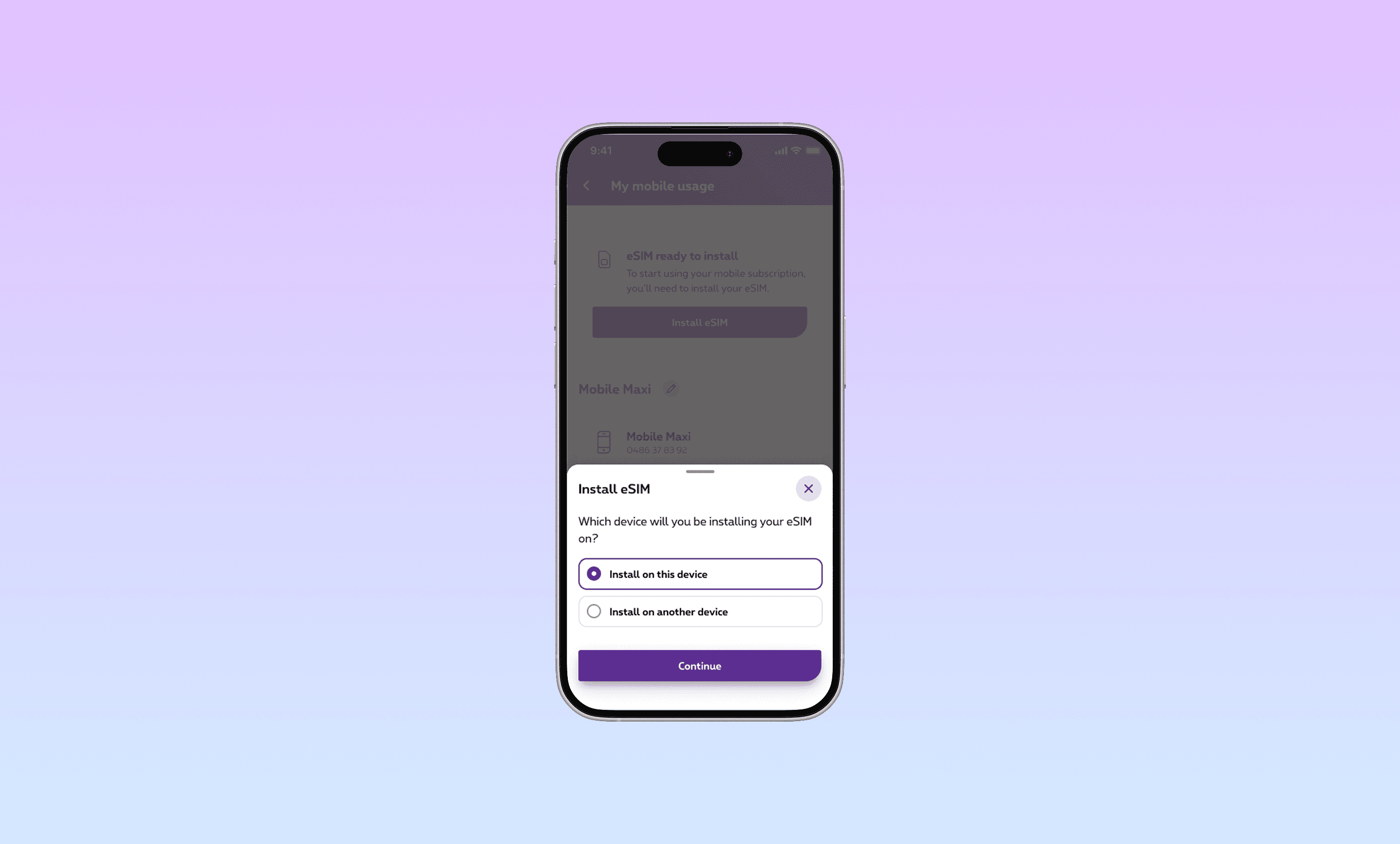
We fully digitised eSIM onboarding, eliminating the need for a mailed QR code and enabling customers to activate directly within the Proximus+ app. The checkout flow was redesigned to clearly explain eSIM benefits, compatibility, and installation steps, raising awareness and helping users make informed choices between physical SIM and eSIM.
Once the eSIM order was processed, customers received an email and a real-time in-app notification guiding them through a step-by-step activation flow. The design included embedded feedback loops, confirming successful installation or directing users to resolution steps when needed.
By integrating onboarding, education, and activation into one continuous journey, we made eSIM simpler, faster, and fully aligned with modern digital expectations.
We fully digitised eSIM onboarding, eliminating the need for a mailed QR code and enabling customers to activate directly within the Proximus+ app. The checkout flow was redesigned to clearly explain eSIM benefits, compatibility, and installation steps, raising awareness and helping users make informed choices between physical SIM and eSIM.
Once the eSIM order was processed, customers received an email and a real-time in-app notification guiding them through a step-by-step activation flow. The design included embedded feedback loops, confirming successful installation or directing users to resolution steps when needed.
By integrating onboarding, education, and activation into one continuous journey, we made eSIM simpler, faster, and fully aligned with modern digital expectations.
We fully digitised eSIM onboarding, eliminating the need for a mailed QR code and enabling customers to activate directly within the Proximus+ app. The checkout flow was redesigned to clearly explain eSIM benefits, compatibility, and installation steps, raising awareness and helping users make informed choices between physical SIM and eSIM.
Once the eSIM order was processed, customers received an email and a real-time in-app notification guiding them through a step-by-step activation flow. The design included embedded feedback loops, confirming successful installation or directing users to resolution steps when needed.
By integrating onboarding, education, and activation into one continuous journey, we made eSIM simpler, faster, and fully aligned with modern digital expectations.
We fully digitised eSIM onboarding, eliminating the need for a mailed QR code and enabling customers to activate directly within the Proximus+ app. The checkout flow was redesigned to clearly explain eSIM benefits, compatibility, and installation steps, raising awareness and helping users make informed choices between physical SIM and eSIM.
Once the eSIM order was processed, customers received an email and a real-time in-app notification guiding them through a step-by-step activation flow. The design included embedded feedback loops, confirming successful installation or directing users to resolution steps when needed.
By integrating onboarding, education, and activation into one continuous journey, we made eSIM simpler, faster, and fully aligned with modern digital expectations.
Impact
Impact
The new digital-first activation flow transformed mobile onboarding from a days-long, paper-dependent process into one that could be completed in minutes.
Because no digital flow existed before this project, the introduction of the new activation journey enabled, rather than increase, successful digital task completion. Over 55% of users activated their eSIM successfully, with a further 25% completing activation despite encountering minor issues.
Beyond immediate performance improvements, the project established the operational foundation needed for future scale, including a dedicated eSIM training programme for support teams. It also positioned Proximus to accommodate the rapid growth of eSIM adoption in Belgium, as consumer behaviour and device ecosystems continue shifting toward digital-first activation.
Ultimately, the solution aligned Proximus with these broader behavioural and technological trends and set the stage for sustained digital growth.
The new digital-first activation flow transformed mobile onboarding from a days-long, paper-dependent process into one that could be completed in minutes.
Because no digital flow existed before this project, the introduction of the new activation journey enabled, rather than increase, successful digital task completion. Over 55% of users activated their eSIM successfully, with a further 25% completing activation despite encountering minor issues.
Beyond immediate performance improvements, the project established the operational foundation needed for future scale, including a dedicated eSIM training programme for support teams. It also positioned Proximus to accommodate the rapid growth of eSIM adoption in Belgium, as consumer behaviour and device ecosystems continue shifting toward digital-first activation.
Ultimately, the solution aligned Proximus with these broader behavioural and technological trends and set the stage for sustained digital growth.
The new digital-first activation flow transformed mobile onboarding from a days-long, paper-dependent process into one that could be completed in minutes.
Because no digital flow existed before this project, the introduction of the new activation journey enabled, rather than increase, successful digital task completion. Over 55% of users activated their eSIM successfully, with a further 25% completing activation despite encountering minor issues.
Beyond immediate performance improvements, the project established the operational foundation needed for future scale, including a dedicated eSIM training programme for support teams. It also positioned Proximus to accommodate the rapid growth of eSIM adoption in Belgium, as consumer behaviour and device ecosystems continue shifting toward digital-first activation.
Ultimately, the solution aligned Proximus with these broader behavioural and technological trends and set the stage for sustained digital growth.
The new digital-first activation flow transformed mobile onboarding from a days-long, paper-dependent process into one that could be completed in minutes.
Because no digital flow existed before this project, the introduction of the new activation journey enabled, rather than increase, successful digital task completion. Over 55% of users activated their eSIM successfully, with a further 25% completing activation despite encountering minor issues.
Beyond immediate performance improvements, the project established the operational foundation needed for future scale, including a dedicated eSIM training programme for support teams. It also positioned Proximus to accommodate the rapid growth of eSIM adoption in Belgium, as consumer behaviour and device ecosystems continue shifting toward digital-first activation.
Ultimately, the solution aligned Proximus with these broader behavioural and technological trends and set the stage for sustained digital growth.