A Quest to Maximise Conversion
A Quest to Maximise Conversion
A Quest to Maximise Conversion
How reframing a mandatory step in the newly designed Proximus checkout process led to a 17% increase in total sales.
How reframing a mandatory step in the newly designed Proximus checkout process led to a 17% increase in total sales.
How reframing a mandatory step in the newly designed Proximus checkout process led to a 17% increase in total sales.
How reframing a mandatory step in the checkout process led to a 17% boost in direct sales.
Executive Summary
Executive Summary
Executive Summary
As part of redesigning Proximus’ acquisition flows, I identified a legally required identification step as a major source of conversion loss. Despite strong performance across the new journeys, this step consistently dragged down completion rates.
By reframing the experience around user behaviour, running targeted A/B tests, and iterating through data-driven improvements, we transformed a rigid, externally managed bottleneck into a streamlined, controlled, and optimised experience.
The result was a measurable uplift: a 15% increase in identification completion and a 17% rise in total orders. This project demonstrated how focused iteration, behavioural insights, and reframing a choice at the right moment can unlock significant business impact in a high-stakes part of the funnel.
As part of redesigning Proximus’ acquisition flows, I identified a legally required identification step as a major source of conversion loss. Despite strong performance across the new journeys, this step consistently dragged down completion rates.
By reframing the experience around user behaviour, running targeted A/B tests, and iterating through data-driven improvements, we transformed a rigid, externally managed bottleneck into a streamlined, controlled, and optimised experience.
The result was a measurable uplift: a 15% increase in identification completion and a 17% rise in total orders. This project demonstrated how focused iteration, behavioural insights, and reframing a choice at the right moment can unlock significant business impact in a high-stakes part of the funnel.
As part of redesigning Proximus’ acquisition flows, I identified a legally required identification step as a major source of conversion loss. Despite strong performance across the new journeys, this step consistently dragged down completion rates.
By reframing the experience around user behaviour, running targeted A/B tests, and iterating through data-driven improvements, we transformed a rigid, externally managed bottleneck into a streamlined, controlled, and optimised experience.
The result was a measurable uplift: a 15% increase in identification completion and a 17% rise in total orders. This project demonstrated how focused iteration, behavioural insights, and reframing a choice at the right moment can unlock significant business impact in a high-stakes part of the funnel.
As part of redesigning Proximus’ acquisition flows, I identified a legally required identification step as a major source of conversion loss. Despite strong performance across the new journeys, this step consistently dragged down completion rates.
By reframing the experience around user behaviour, running targeted A/B tests, and iterating through data-driven improvements, we transformed a rigid, externally managed bottleneck into a streamlined, controlled, and optimised experience.
The result was a measurable uplift: a 15% increase in identification completion and a 17% rise in total orders. This project demonstrated how focused iteration, behavioural insights, and reframing a choice at the right moment can unlock significant business impact in a high-stakes part of the funnel.
Problem
Problem
As part of redesigning Proximus’ acquisition flows, I identified a legally required identification step as a major source of conversion loss. Despite strong performance across the new journeys, this step consistently dragged down completion rates.
By reframing the experience around user behaviour, running targeted A/B tests, and iterating through data-driven improvements, we transformed a rigid, externally managed bottleneck into a streamlined, controlled, and optimised experience.
The result was a measurable uplift: a 15% increase in identification completion and a 17% rise in total orders. This project demonstrated how focused iteration, behavioural insights, and reframing a choice at the right moment can unlock significant business impact in a high-stakes part of the funnel.
As part of redesigning Proximus’ acquisition flows, I identified a legally required identification step as a major source of conversion loss. Despite strong performance across the new journeys, this step consistently dragged down completion rates.
By reframing the experience around user behaviour, running targeted A/B tests, and iterating through data-driven improvements, we transformed a rigid, externally managed bottleneck into a streamlined, controlled, and optimised experience.
The result was a measurable uplift: a 15% increase in identification completion and a 17% rise in total orders. This project demonstrated how focused iteration, behavioural insights, and reframing a choice at the right moment can unlock significant business impact in a high-stakes part of the funnel.
As part of redesigning Proximus’ acquisition flows, I identified a legally required identification step as a major source of conversion loss. Despite strong performance across the new journeys, this step consistently dragged down completion rates.
By reframing the experience around user behaviour, running targeted A/B tests, and iterating through data-driven improvements, we transformed a rigid, externally managed bottleneck into a streamlined, controlled, and optimised experience.
The result was a measurable uplift: a 15% increase in identification completion and a 17% rise in total orders. This project demonstrated how focused iteration, behavioural insights, and reframing a choice at the right moment can unlock significant business impact in a high-stakes part of the funnel.
As part of redesigning Proximus’ acquisition flows, I identified a legally required identification step as a major source of conversion loss. Despite strong performance across the new journeys, this step consistently dragged down completion rates.
By reframing the experience around user behaviour, running targeted A/B tests, and iterating through data-driven improvements, we transformed a rigid, externally managed bottleneck into a streamlined, controlled, and optimised experience.
The result was a measurable uplift: a 15% increase in identification completion and a 17% rise in total orders. This project demonstrated how focused iteration, behavioural insights, and reframing a choice at the right moment can unlock significant business impact in a high-stakes part of the funnel.
Approach and Design Process
Approach and Design Process
We began by analysing behavioural data to understand why drop-off was so high. Our analysis showed we reached the highest rate of conversion when users chose itsme as their identification method.
Based on this, we formed a hypothesis around simplifying the step and tested an itsme-only variant through a long-running A/B test. The results showed that even with a single identification method (itsme only), we achieved the same level of conversion as the previous version offering three methods. This confirmed that simplification carried no risk and validated our direction.
Once we regained full ownership of the step and implemented the single identification method, we ran iterative optimisation cycles using Contentsquare zoning analysis and user testing to address friction points.
We refined CTA visibility, softened the CTA language, and removed competing visual elements. When improvements plateaued, we revisited patterns in other successful steps of the checkout flow, which inspired a new contrast-based reframing strategy.
We began by analysing behavioural data to understand why drop-off was so high. Our analysis showed we reached the highest rate of conversion when users chose itsme as their identification method.
Based on this, we formed a hypothesis around simplifying the step and tested an itsme-only variant through a long-running A/B test. The results showed that even with a single identification method (itsme only), we achieved the same level of conversion as the previous version offering three methods. This confirmed that simplification carried no risk and validated our direction.
Once we regained full ownership of the step and implemented the single identification method, we ran iterative optimisation cycles using Contentsquare zoning analysis and user testing to address friction points.
We refined CTA visibility, softened the CTA language, and removed competing visual elements. When improvements plateaued, we revisited patterns in other successful steps of the checkout flow, which inspired a new contrast-based reframing strategy.
We began by analysing behavioural data to understand why drop-off was so high. Our analysis showed we reached the highest rate of conversion when users chose itsme as their identification method.
Based on this, we formed a hypothesis around simplifying the step and tested an itsme-only variant through a long-running A/B test. The results showed that even with a single identification method (itsme only), we achieved the same level of conversion as the previous version offering three methods. This confirmed that simplification carried no risk and validated our direction.
Once we regained full ownership of the step and implemented the single identification method, we ran iterative optimisation cycles using Contentsquare zoning analysis and user testing to address friction points.
We refined CTA visibility, softened the CTA language, and removed competing visual elements. When improvements plateaued, we revisited patterns in other successful steps of the checkout flow, which inspired a new contrast-based reframing strategy.
We began by analysing behavioural data to understand why drop-off was so high. Our analysis showed we reached the highest rate of conversion when users chose itsme as their identification method.
Based on this, we formed a hypothesis around simplifying the step and tested an itsme-only variant through a long-running A/B test. The results showed that even with a single identification method (itsme only), we achieved the same level of conversion as the previous version offering three methods. This confirmed that simplification carried no risk and validated our direction.
Once we regained full ownership of the step and implemented the single identification method, we ran iterative optimisation cycles using Contentsquare zoning analysis and user testing to address friction points.
We refined CTA visibility, softened the CTA language, and removed competing visual elements. When improvements plateaued, we revisited patterns in other successful steps of the checkout flow, which inspired a new contrast-based reframing strategy.
Solution
Solution
The final solution centred on making itsme the obvious choice. First, we replaced the outdated iframe with a clean, native interface featuring a single, streamlined itsme flow. Sticky CTAs ensured the primary action remained visible, and revised copy reduced perceived risk by clarifying that users were simply beginning identification rather than committing to an irreversible step.
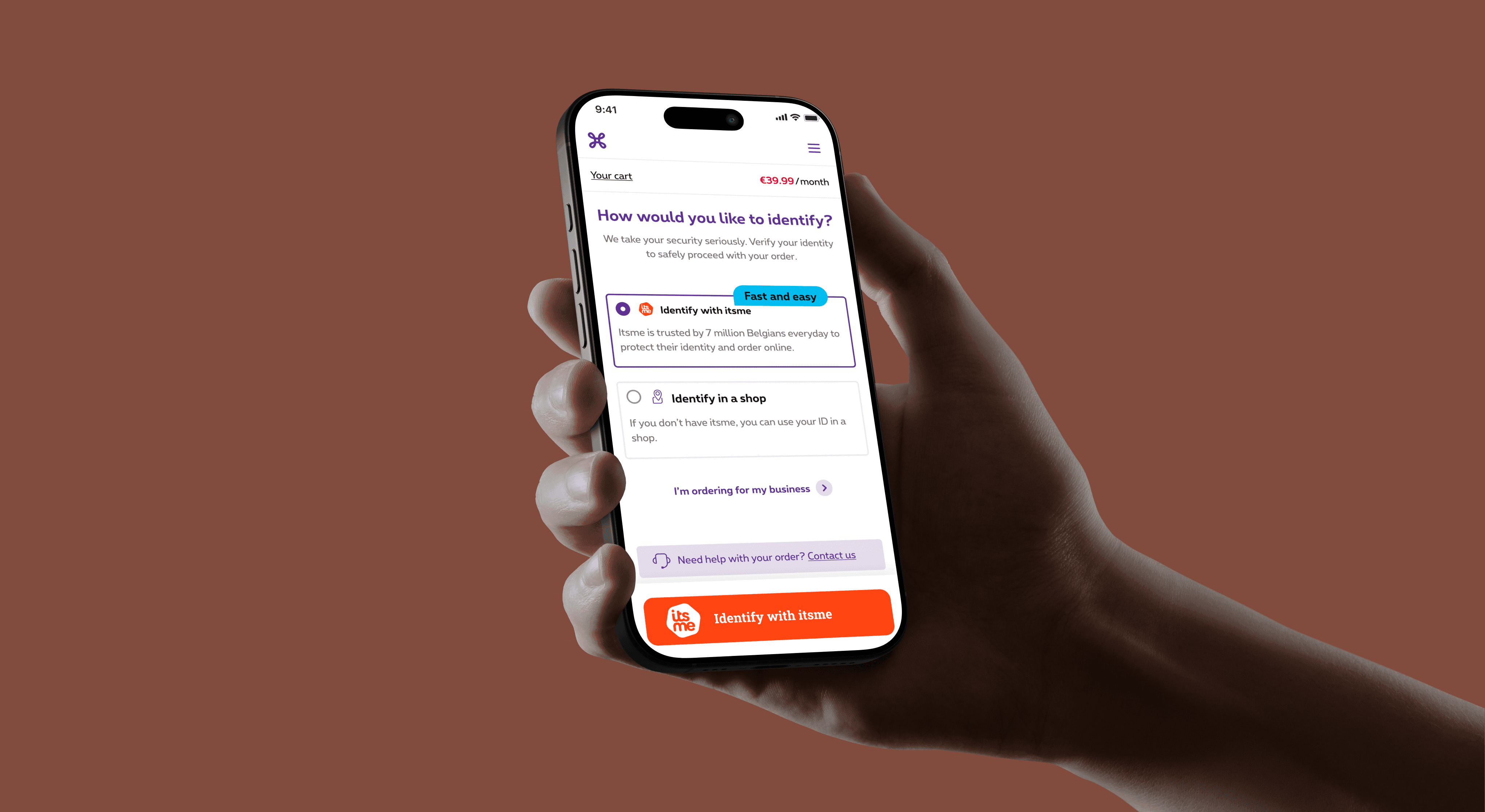
When incremental refinements plateaued, we introduced a new framing strategy: presenting itsme alongside a deliberate contrast. We added a second option: verifying identity in a physical Proximus shop, a slower and less convenient alternative that required users to interrupt their online journey.
By placing both options side by side, we created a natural comparison that highlighted itsme as the faster, simpler, and more intuitive path forward, helping users make a confident decision at a critical moment in the flow.
The final solution centred on making itsme the obvious choice. First, we replaced the outdated iframe with a clean, native interface featuring a single, streamlined itsme flow. Sticky CTAs ensured the primary action remained visible, and revised copy reduced perceived risk by clarifying that users were simply beginning identification rather than committing to an irreversible step.
When incremental refinements plateaued, we introduced a new framing strategy: presenting itsme alongside a deliberate contrast. We added a second option: verifying identity in a physical Proximus shop, a slower and less convenient alternative that required users to interrupt their online journey.
By placing both options side by side, we created a natural comparison that highlighted itsme as the faster, simpler, and more intuitive path forward, helping users make a confident decision at a critical moment in the flow.
The final solution centred on making itsme the obvious choice. First, we replaced the outdated iframe with a clean, native interface featuring a single, streamlined itsme flow. Sticky CTAs ensured the primary action remained visible, and revised copy reduced perceived risk by clarifying that users were simply beginning identification rather than committing to an irreversible step.
When incremental refinements plateaued, we introduced a new framing strategy: presenting itsme alongside a deliberate contrast. We added a second option: verifying identity in a physical Proximus shop, a slower and less convenient alternative that required users to interrupt their online journey.
By placing both options side by side, we created a natural comparison that highlighted itsme as the faster, simpler, and more intuitive path forward, helping users make a confident decision at a critical moment in the flow.
The final solution centred on making itsme the obvious choice. First, we replaced the outdated iframe with a clean, native interface featuring a single, streamlined itsme flow. Sticky CTAs ensured the primary action remained visible, and revised copy reduced perceived risk by clarifying that users were simply beginning identification rather than committing to an irreversible step.
When incremental refinements plateaued, we introduced a new framing strategy: presenting itsme alongside a deliberate contrast. We added a second option: verifying identity in a physical Proximus shop, a slower and less convenient alternative that required users to interrupt their online journey.
By placing both options side by side, we created a natural comparison that highlighted itsme as the faster, simpler, and more intuitive path forward, helping users make a confident decision at a critical moment in the flow.
Impact
Impact
The redesigned identification step delivered a significant uplift across the funnel. The introduction of the itsme-only flow immediately improved completion rates, and successive UX refinements helped remove remaining friction. Once we reframed the decision by adding the physical-store alternative, identification completion rose by 15%, which in turn drove a 17% increase in total completed orders.
Beyond these measurable gains, the project delivered strategic value. We regained full control over a previously externalised step, reduced operational complexity, and restored complete data visibility. Aligning the flow with evolving user behaviour also strengthened its effectiveness: since the Covid pandemic, itsme adoption in Belgium had grown rapidly, becoming a trusted standard across public and private services requiring secure identification.
By transforming a critical bottleneck into a streamlined, user-centred step, we unlocked meaningful business impact at scale.
The redesigned identification step delivered a significant uplift across the funnel. The introduction of the itsme-only flow immediately improved completion rates, and successive UX refinements helped remove remaining friction. Once we reframed the decision by adding the physical-store alternative, identification completion rose by 15%, which in turn drove a 17% increase in total completed orders.
Beyond these measurable gains, the project delivered strategic value. We regained full control over a previously externalised step, reduced operational complexity, and restored complete data visibility. Aligning the flow with evolving user behaviour also strengthened its effectiveness: since the Covid pandemic, itsme adoption in Belgium had grown rapidly, becoming a trusted standard across public and private services requiring secure identification.
By transforming a critical bottleneck into a streamlined, user-centred step, we unlocked meaningful business impact at scale.
The redesigned identification step delivered a significant uplift across the funnel. The introduction of the itsme-only flow immediately improved completion rates, and successive UX refinements helped remove remaining friction. Once we reframed the decision by adding the physical-store alternative, identification completion rose by 15%, which in turn drove a 17% increase in total completed orders.
Beyond these measurable gains, the project delivered strategic value. We regained full control over a previously externalised step, reduced operational complexity, and restored complete data visibility. Aligning the flow with evolving user behaviour also strengthened its effectiveness: since the Covid pandemic, itsme adoption in Belgium had grown rapidly, becoming a trusted standard across public and private services requiring secure identification.
By transforming a critical bottleneck into a streamlined, user-centred step, we unlocked meaningful business impact at scale.
The redesigned identification step delivered a significant uplift across the funnel. The introduction of the itsme-only flow immediately improved completion rates, and successive UX refinements helped remove remaining friction. Once we reframed the decision by adding the physical-store alternative, identification completion rose by 15%, which in turn drove a 17% increase in total completed orders.
Beyond these measurable gains, the project delivered strategic value. We regained full control over a previously externalised step, reduced operational complexity, and restored complete data visibility. Aligning the flow with evolving user behaviour also strengthened its effectiveness: since the Covid pandemic, itsme adoption in Belgium had grown rapidly, becoming a trusted standard across public and private services requiring secure identification.
By transforming a critical bottleneck into a streamlined, user-centred step, we unlocked meaningful business impact at scale.