Navigating a New Era of Connectivity
Navigating a New Era of Connectivity
Navigating a New Era of Connectivity
How a dual-track strategy aligned created a scalable, future-proof ecosystem and accelerated eSIM adoption.
How a dual-track strategy aligned created a scalable, future-proof ecosystem and accelerated eSIM adoption.
How a dual-track strategy aligned created a scalable, future-proof ecosystem and accelerated eSIM adoption.
Executive Summary
Executive Summary
Executive Summary
As eSIM adoption accelerated across Europe, Proximus faced a critical challenge: existing customers still needed to visit a store to switch from a physical SIM to an eSIM. This contradicted the digital-first promise of eSIM and placed unnecessary pressure on retail channels.
To bridge the gap, we designed and implemented a fully digital SIM-to-eSIM swap within the Proximus+ app while simultaneously preparing the long-term “Quick Transfer” solution in partnership with vendors and device manufacturers.
This dual-track approach ensured customers could transition smoothly to eSIM, even before full native capabilities were available, while positioning Proximus at the forefront of digital connectivity. The result was a future-proof, scalable system ready for the arrival of eSIM-only devices in the European market.
As eSIM adoption accelerated across Europe, Proximus faced a critical challenge: existing customers still needed to visit a store to switch from a physical SIM to an eSIM. This contradicted the digital-first promise of eSIM and placed unnecessary pressure on retail channels.
To bridge the gap, we designed and implemented a fully digital SIM-to-eSIM swap within the Proximus+ app while simultaneously preparing the long-term “Quick Transfer” solution in partnership with vendors and device manufacturers.
This dual-track approach ensured customers could transition smoothly to eSIM, even before full native capabilities were available, while positioning Proximus at the forefront of digital connectivity. The result was a future-proof, scalable system ready for the arrival of eSIM-only devices in the European market.
As eSIM adoption accelerated across Europe, Proximus faced a critical challenge: existing customers still needed to visit a store to switch from a physical SIM to an eSIM. This contradicted the digital-first promise of eSIM and placed unnecessary pressure on retail channels.
To bridge the gap, we designed and implemented a fully digital SIM-to-eSIM swap within the Proximus+ app while simultaneously preparing the long-term “Quick Transfer” solution in partnership with vendors and device manufacturers.
This dual-track approach ensured customers could transition smoothly to eSIM, even before full native capabilities were available, while positioning Proximus at the forefront of digital connectivity. The result was a future-proof, scalable system ready for the arrival of eSIM-only devices in the European market.
As eSIM adoption accelerated across Europe, Proximus faced a critical challenge: existing customers still needed to visit a store to switch from a physical SIM to an eSIM. This contradicted the digital-first promise of eSIM and placed unnecessary pressure on retail channels.
To bridge the gap, we designed and implemented a fully digital SIM-to-eSIM swap within the Proximus+ app while simultaneously preparing the long-term “Quick Transfer” solution in partnership with vendors and device manufacturers.
This dual-track approach ensured customers could transition smoothly to eSIM, even before full native capabilities were available, while positioning Proximus at the forefront of digital connectivity. The result was a future-proof, scalable system ready for the arrival of eSIM-only devices in the European market.
Problem
Problem
Problem
Problem
With Europe’s first eSIM-only devices approaching launch, Proximus lacked a digital process for existing customers wishing to switch from a physical SIM to an eSIM. New customers could activate an eSIM digitally, but current customers were still required to visit a store — an approach that undermined the convenience of eSIM, created friction, and added unnecessary operational load for retail teams. Vendor-enabled solutions such as Quick Transfer were being explored, but they required technical alignment with manufacturers and were not ready in time for the market shift.
As adoption of eSIM grew rapidly and device compatibility increased, Proximus needed an immediate, fully digital self-service solution that could support rising demand, bridge the gap until Quick Transfer could be deployed, and align with evolving user expectations for effortless, app-based management.
With Europe’s first eSIM-only devices approaching launch, Proximus lacked a digital process for existing customers wishing to switch from a physical SIM to an eSIM. New customers could activate an eSIM digitally, but current customers were still required to visit a store — an approach that undermined the convenience of eSIM, created friction, and added unnecessary operational load for retail teams. Vendor-enabled solutions such as Quick Transfer were being explored, but they required technical alignment with manufacturers and were not ready in time for the market shift.
As adoption of eSIM grew rapidly and device compatibility increased, Proximus needed an immediate, fully digital self-service solution that could support rising demand, bridge the gap until Quick Transfer could be deployed, and align with evolving user expectations for effortless, app-based management.
With Europe’s first eSIM-only devices approaching launch, Proximus lacked a digital process for existing customers wishing to switch from a physical SIM to an eSIM. New customers could activate an eSIM digitally, but current customers were still required to visit a store — an approach that undermined the convenience of eSIM, created friction, and added unnecessary operational load for retail teams. Vendor-enabled solutions such as Quick Transfer were being explored, but they required technical alignment with manufacturers and were not ready in time for the market shift.
As adoption of eSIM grew rapidly and device compatibility increased, Proximus needed an immediate, fully digital self-service solution that could support rising demand, bridge the gap until Quick Transfer could be deployed, and align with evolving user expectations for effortless, app-based management.
With Europe’s first eSIM-only devices approaching launch, Proximus lacked a digital process for existing customers wishing to switch from a physical SIM to an eSIM. New customers could activate an eSIM digitally, but current customers were still required to visit a store — an approach that undermined the convenience of eSIM, created friction, and added unnecessary operational load for retail teams. Vendor-enabled solutions such as Quick Transfer were being explored, but they required technical alignment with manufacturers and were not ready in time for the market shift.
As adoption of eSIM grew rapidly and device compatibility increased, Proximus needed an immediate, fully digital self-service solution that could support rising demand, bridge the gap until Quick Transfer could be deployed, and align with evolving user expectations for effortless, app-based management.
Approach and Design Process
Approach and Design Process
Approach and Design Process
Approach and Design Process
To understand how Proximus should support the shift toward eSIM-enabled devices, I began with desk research and competitive benchmarking, which showed that many operators already offered digital SIM-swap capabilities directly in their apps. To validate whether this direction met user needs, I interviewed customers familiar with eSIM as well as fleet managers overseeing employee devices. Across both groups, the expectation was clear: eSIM is inherently digital, and users wanted to manage the swap themselves without visiting a store.
We then iterated on a self-service SIM-to-eSIM swap flow and ran two rounds of user testing to assess usability and evaluate how well it aligned with the existing eSIM activation journey in the Proximus+ app. Testing helped us refine explanations, reduce friction, and ensure the flow felt intuitive and coherent end to end.
These insights shaped the final design while the long-term Quick Transfer solution continued development in parallel.
To understand how Proximus should support the shift toward eSIM-enabled devices, I began with desk research and competitive benchmarking, which showed that many operators already offered digital SIM-swap capabilities directly in their apps. To validate whether this direction met user needs, I interviewed customers familiar with eSIM as well as fleet managers overseeing employee devices. Across both groups, the expectation was clear: eSIM is inherently digital, and users wanted to manage the swap themselves without visiting a store.
We then iterated on a self-service SIM-to-eSIM swap flow and ran two rounds of user testing to assess usability and evaluate how well it aligned with the existing eSIM activation journey in the Proximus+ app. Testing helped us refine explanations, reduce friction, and ensure the flow felt intuitive and coherent end to end.
These insights shaped the final design while the long-term Quick Transfer solution continued development in parallel.
To understand how Proximus should support the shift toward eSIM-enabled devices, I began with desk research and competitive benchmarking, which showed that many operators already offered digital SIM-swap capabilities directly in their apps. To validate whether this direction met user needs, I interviewed customers familiar with eSIM as well as fleet managers overseeing employee devices. Across both groups, the expectation was clear: eSIM is inherently digital, and users wanted to manage the swap themselves without visiting a store.
We then iterated on a self-service SIM-to-eSIM swap flow and ran two rounds of user testing to assess usability and evaluate how well it aligned with the existing eSIM activation journey in the Proximus+ app. Testing helped us refine explanations, reduce friction, and ensure the flow felt intuitive and coherent end to end.
These insights shaped the final design while the long-term Quick Transfer solution continued development in parallel.
To understand how Proximus should support the shift toward eSIM-enabled devices, I began with desk research and competitive benchmarking, which showed that many operators already offered digital SIM-swap capabilities directly in their apps. To validate whether this direction met user needs, I interviewed customers familiar with eSIM as well as fleet managers overseeing employee devices. Across both groups, the expectation was clear: eSIM is inherently digital, and users wanted to manage the swap themselves without visiting a store.
We then iterated on a self-service SIM-to-eSIM swap flow and ran two rounds of user testing to assess usability and evaluate how well it aligned with the existing eSIM activation journey in the Proximus+ app. Testing helped us refine explanations, reduce friction, and ensure the flow felt intuitive and coherent end to end.
These insights shaped the final design while the long-term Quick Transfer solution continued development in parallel.
Solution
Solution
Solution
Solution
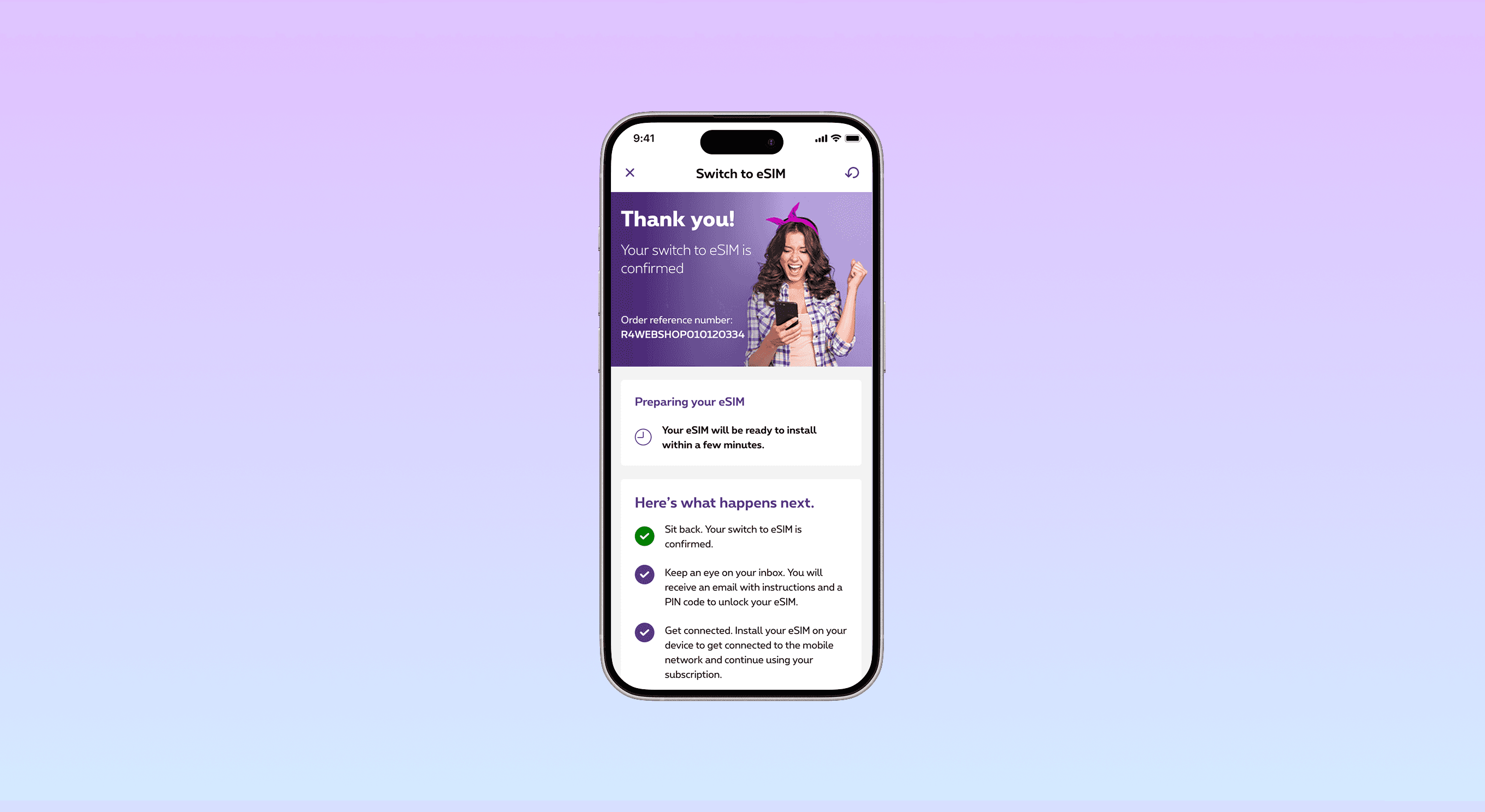
We introduced a fully digital SIM-to-eSIM swapping experience in the Proximus+ app, allowing existing customers to transition effortlessly without visiting a store. Building on earlier eSIM onboarding work, the flow guided users through compatibility checks, clear explanations of the impact on their physical SIM, and a secure two-factor verification using itsme. This solution aligned the process with the digital nature of eSIM and delivered the simplicity users expected.
In parallel, we prepared the Quick Transfer solution — a native method that enables users to convert a SIM on their device or move it from one device to another seamlessly. Together, these solutions ensured continuity for all user scenarios, with the digital self-service swap acting as both an immediate answer to growing demand and a fallback for edge cases Quick Transfer cannot cover.
We introduced a fully digital SIM-to-eSIM swapping experience in the Proximus+ app, allowing existing customers to transition effortlessly without visiting a store. Building on earlier eSIM onboarding work, the flow guided users through compatibility checks, clear explanations of the impact on their physical SIM, and a secure two-factor verification using itsme. This solution aligned the process with the digital nature of eSIM and delivered the simplicity users expected.
In parallel, we prepared the Quick Transfer solution — a native method that enables users to convert a SIM on their device or move it from one device to another seamlessly. Together, these solutions ensured continuity for all user scenarios, with the digital self-service swap acting as both an immediate answer to growing demand and a fallback for edge cases Quick Transfer cannot cover.
We introduced a fully digital SIM-to-eSIM swapping experience in the Proximus+ app, allowing existing customers to transition effortlessly without visiting a store. Building on earlier eSIM onboarding work, the flow guided users through compatibility checks, clear explanations of the impact on their physical SIM, and a secure two-factor verification using itsme. This solution aligned the process with the digital nature of eSIM and delivered the simplicity users expected.
In parallel, we prepared the Quick Transfer solution — a native method that enables users to convert a SIM on their device or move it from one device to another seamlessly. Together, these solutions ensured continuity for all user scenarios, with the digital self-service swap acting as both an immediate answer to growing demand and a fallback for edge cases Quick Transfer cannot cover.
We introduced a fully digital SIM-to-eSIM swapping experience in the Proximus+ app, allowing existing customers to transition effortlessly without visiting a store. Building on earlier eSIM onboarding work, the flow guided users through compatibility checks, clear explanations of the impact on their physical SIM, and a secure two-factor verification using itsme. This solution aligned the process with the digital nature of eSIM and delivered the simplicity users expected.
In parallel, we prepared the Quick Transfer solution — a native method that enables users to convert a SIM on their device or move it from one device to another seamlessly. Together, these solutions ensured continuity for all user scenarios, with the digital self-service swap acting as both an immediate answer to growing demand and a fallback for edge cases Quick Transfer cannot cover.
Impact
Impact
Impact
Impact
Proximus became one of the first Belgian operators to offer a fully digital SIM-to-eSIM swap for existing customers, eliminating the need for store visits and reducing pressure on retail channels. The self-service flow was rolled out across both consumer and business customers and quickly gained traction, averaging 55 digital swaps per day. With the launch of Quick Transfer, adoption accelerated further, enabling over 14,000 new eSIM activations within the first month.
Together, the digital swap and Quick Transfer formed a resilient, future-proof ecosystem that aligned Proximus with shifting device trends, supported the rise of eSIM-only devices, and delivered on the expectation of frictionless, digital-first connectivity.
Proximus became one of the first Belgian operators to offer a fully digital SIM-to-eSIM swap for existing customers, eliminating the need for store visits and reducing pressure on retail channels. The self-service flow was rolled out across both consumer and business customers and quickly gained traction, averaging 55 digital swaps per day. With the launch of Quick Transfer, adoption accelerated further, enabling over 14,000 new eSIM activations within the first month.
Together, the digital swap and Quick Transfer formed a resilient, future-proof ecosystem that aligned Proximus with shifting device trends, supported the rise of eSIM-only devices, and delivered on the expectation of frictionless, digital-first connectivity.
Proximus became one of the first Belgian operators to offer a fully digital SIM-to-eSIM swap for existing customers, eliminating the need for store visits and reducing pressure on retail channels. The self-service flow was rolled out across both consumer and business customers and quickly gained traction, averaging 55 digital swaps per day. With the launch of Quick Transfer, adoption accelerated further, enabling over 14,000 new eSIM activations within the first month.
Together, the digital swap and Quick Transfer formed a resilient, future-proof ecosystem that aligned Proximus with shifting device trends, supported the rise of eSIM-only devices, and delivered on the expectation of frictionless, digital-first connectivity.
Proximus became one of the first Belgian operators to offer a fully digital SIM-to-eSIM swap for existing customers, eliminating the need for store visits and reducing pressure on retail channels. The self-service flow was rolled out across both consumer and business customers and quickly gained traction, averaging 55 digital swaps per day. With the launch of Quick Transfer, adoption accelerated further, enabling over 14,000 new eSIM activations within the first month.
Together, the digital swap and Quick Transfer formed a resilient, future-proof ecosystem that aligned Proximus with shifting device trends, supported the rise of eSIM-only devices, and delivered on the expectation of frictionless, digital-first connectivity.